
Knowing and understanding EPA and RCRA regulations is challenging enough, but when states such as California add their own wrinkles into the equation, things get even tougher.
Our guide helps you better understand the differences between federal and California hazardous waste regulations and how to protect yourself and your business.
For EHS managers at California facilities, the practical implication is straightforward: federal compliance is the starting point, not the finish line.
California’s Dual Regulatory Authority
Under federal guidelines, the Environmental Protection Agency and the Resource Conservation and Recovery Act preside over the handling and disposal of hazardous waste.
But under the RCRA, there is a provision that allows individual states to apply for “authorization” to run their own hazardous waste programs in place of the federal program, as long as they are at least as strict as the federal government’s regulations.
California established the Department of Toxic Substances Control to serve as the primary environmental agency for hazardous waste oversight; it is the primary agency responsible for hazardous waste oversight in California on a day-to-day basis.
Rather than work with the EPA, California hazardous waste generators are filing paperwork, getting inspected, and receiving penalties from the DTSC.
California’s environmental protections and regulations are stricter than the EPA’s, so hazardous waste generators must keep a closer eye on their hazardous waste to avoid penalties.
A generator that is fully compliant with federal RCRA requirements could still violate California law.
But the EPA isn’t entirely out of the picture either.
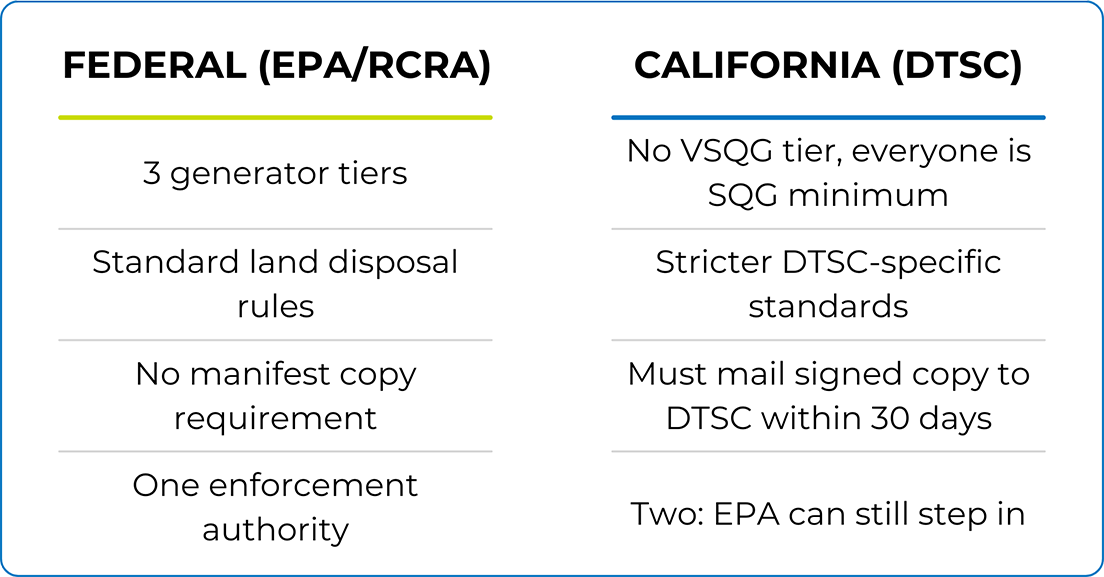
The EPA retains oversight authority and can still step in to enforce, particularly for violations of federal law.
So in a worst-case scenario, a California generator facing a serious violation could be dealing with both agencies at once.
That’s why it is so important for hazardous waste generators to understand their local rules and regulations, as California is just one of a few states that follow a more rigorous set of rules.
Where California’s Rules Diverge (and Get Stricter)
There are four major areas where California’s hazardous waste regulations differ from the federal government’s: universal waste, land disposal regulations, generator classifications, and reporting requirements.
Federal universal waste guidelines simplify waste and handling for some common hazardous wastes. California uses this list, but also adds additional items to it. While this does make handling and disposing of some hazardous wastes easier, the catch is that you must also follow their stricter regulations.
This list changes often, so the best resource for identifying which hazardous wastes are universal is to visit their website.
Federal Land Disposal rules require that hazardous waste meet certain treatment standards before it can be disposed of in a landfill. That might mean the hazardous waste must reach a certain level of toxicity, or volume, before the next steps.
California has its own standards found on the DTSC website. Keep an eye out for your specific types of waste, as the requirements may differ from federal regulations.
Under federal RCRA, there are three generator tiers: Very Small Quantity Generator (VSQG, formerly CESQG), Small Quantity Generator (SQG), and Large Quantity Generator (LQG).
Because California never adopted the CESQG regulations, generators producing less than 1,000 kg of hazardous waste per month are still classified as small-quantity generators.
Whereas in some states, a facility would qualify federally under the lowest-burden tier for hazardous waste generation, that doesn’t happen in California. Because of this, all hazardous waste generators must follow guidelines for storage, labeling, training, and reporting.
California adds a layer that trips up generators unfamiliar with the state rules.
If a paper manifest is used at any point during waste shipments, the generator must mail a copy of the manifest, signed by the generator and the first transporter, to DTSC within 30 days.
This is a California-specific requirement, as most states don’t require generators to proactively submit manifest copies to the state agency.
The only exception is a fully electronic manifest, where the manifest is created electronically in e-Manifest and signed electronically by all handlers.
Why California Environmental Penalties Hit Harder
Understanding California’s penalty structure requires understanding something that is easy to overlook: DTSC and the EPA are separate enforcement authorities.
A violation in California does not get resolved with one agency and then disappear.
Both can pursue enforcement independently, and in serious cases, generators can find themselves responding to both simultaneously.
That dual exposure is the starting point for understanding why non-compliance costs more in California than in most other states.
Civil Penalties
California has significantly raised the ceiling on civil penalties for hazardous waste violations in recent years.
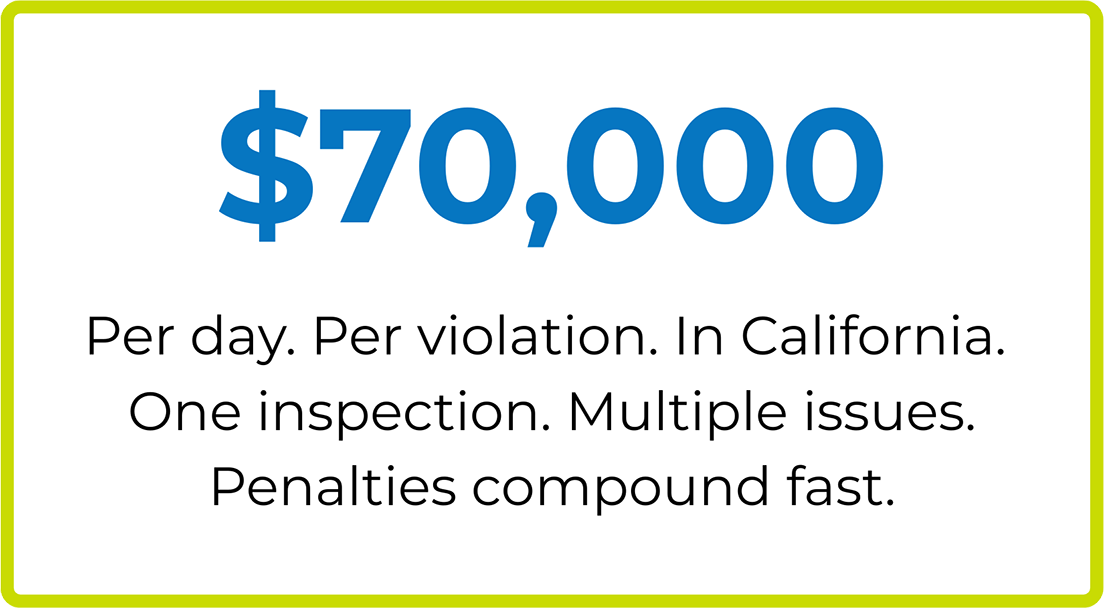
Fines can now reach up to $70,000 per day per violation, depending on the potential harm caused and the extent of deviation from regulatory requirements (California Health and Safety Code, Chapter 6.5).
That figure applies per violation, meaning a single inspection that uncovers multiple issues — mislabeled containers, missing manifest copies, improper storage — can quickly generate compounding penalties.
Criminal Liability
California’s enforcement reach extends beyond financial penalties.
Improper treatment or storage of hazardous waste can, under certain circumstances, inadvertently reclassify a facility as a Treatment, Storage, and Disposal Facility (TSDF).
A TSDF designation requires a separate, complex operating permit from DTSC, and operating without one carries its own set of consequences.
The Public Record Problem
One enforcement consequence that financial penalty figures alone do not capture is visibility.
DTSC maintains EnviroStor, a publicly accessible database that documents enforcement actions, violations, and cleanup sites across California.
When a facility receives a citation or enters into a consent order, that information becomes part of a searchable public record.
For facilities that work with clients, partners, or regulators who conduct environmental due diligence, a visible enforcement history carries reputational consequences that extend well beyond the cost of the original penalty.
Prospective customers, lenders, and acquirers routinely search EnviroStor as part of their assessment of California-based industrial facilities.
Are You a Hazardous Waste Generator in California? Get Help Today with HWH Environmental.
Whether you’re a small or large hazardous waste generator in California, HWH Environmental is here to help you with all of your disposal needs. Call us at 877-777-6708 or contact us online for more information.